IGP COMPETITION — HAVE WE LOST SIGHT OF WHY IT WAS CREATED?
There is something I believe deserves a serious discussion within the working dog community.
First, the name changed from Schutzhund to IPO, and eventually to IGP.
But why?
Was it simply an evolution of the sport, or did changing public perception, political sensitivities, animal rights activism, and outside pressures influence decisions that ultimately changed how we identify and present our sport?
Has the influence of public opinion become so powerful that even the terminology associated with our working dog heritage must be reconsidered?
Unfortunately, the changes have not stopped with the name.
Over the years, we have also seen significant technical changes to the sport itself.
Let’s remember something important.
Schutzhund was not originally created simply to entertain competitors or award titles. It was developed as a working dog evaluation and breeding tool, particularly for the German Shepherd. It provided breeders and working dog enthusiasts with something exceptionally valuable/ an opportunity to evaluate a dog’s temperament, courage, confidence, stability, obedience, tracking ability, and willingness to work under pressure. Three disciplines, combined into one sport, offered a unique opportunity to evaluate the complete working dog.
The training was not simply about teaching exercises. It was about exposing the dog’s character, identifying its strengths and weaknesses, and determining whether it possessed the qualities necessary to contribute to future generations in a breeding program. That was the philosophy behind it.
Today, I question whether we are moving further away from that original purpose. Consider some of the technical changes over the years:
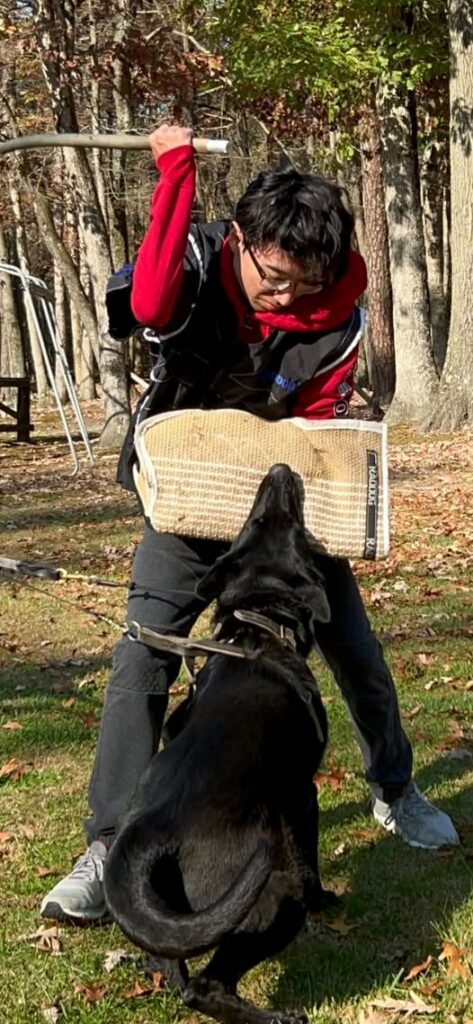
• The removal of the stick contact during the protection phase, which historically provided an opportunity to evaluate the dog’s ability to withstand physical pressure.
• Changes to the scaling wall and other exercises that alter the physical and mental demands placed on the dog.
The removal of the dumbbell for the lower title on the meter jump, an exercise that presented a considerable challenge and required a combination of athletic ability, commitment, and precision.
These are not insignificant details. They change what we ask of the dog and what we are able to evaluate.
The FCI is a large, international, all-breed organization, responsible for overseeing many different breeds and their respective regulations. While it has breed specific committees, its overall governance is much broader than the interests of any one working breed.
As a German Shepherd enthusiast, I also look at the SV and the WUSV and question whether the direction of these organizations continues to reflect the interests of the serious working dog breeder.
The WUSV operates within the broader FCI framework, and I believe we should be asking whether enough is being done to preserve the original working purpose of our breed.
My concern is not about resisting change simply because things were done differently in the past.
Sports evolve. Rules change. Improvements are sometimes necessary.
But change should have a purpose, and that purpose should be to improve the quality of the working dog, not gradually dilute the standards that made the sport meaningful in the first place.
I have spent more than 35 years breeding, training, and competing German Shepherds. My perspective comes from a lifetime of working with these dogs, not simply watching a competition from the sidelines.
I believe we need to ask ourselves some difficult questions:
Are we still evaluating the complete working German Shepherd?
Are we protecting the working character, temperament, courage, and resilience that this breed was developed to possess?
Or are we gradually adapting the sport to accommodate everything around it, while losing sight of the very reasons it was created?
A working title should represent something meaningful. It should tell us something about the dog, its character, its ability, and its suitability for future generations.
We must never forget that the sport should serve the working dog and the breed NOT the other way around.
The question is simple: Are we preserving the working German Shepherd, or are we changing the definition of what a working German Shepherd should be?